


In short
When it comes to comprehensive information protection and security, it doesn’t get better than an ISMS (Information Security Management System). It is essentially an umbrella term that comprises a company’s total policies about its security, implementation and practices,
In this article
An information security management system (ISMS) is a documented set of policies, processes and controls for managing information risk, together with the governance to keep it current. It is not software. It is the framework that decides which security controls you need, records why, assigns owners, and proves the whole thing is being reviewed.
The term comes from ISO/IEC 27001, the international standard that defines what an ISMS must contain. Most businesses encounter it for the first time because a customer, insurer or regulator has asked whether they have one.
Think your IT is in good shape?

What is an ISMS in plain terms?
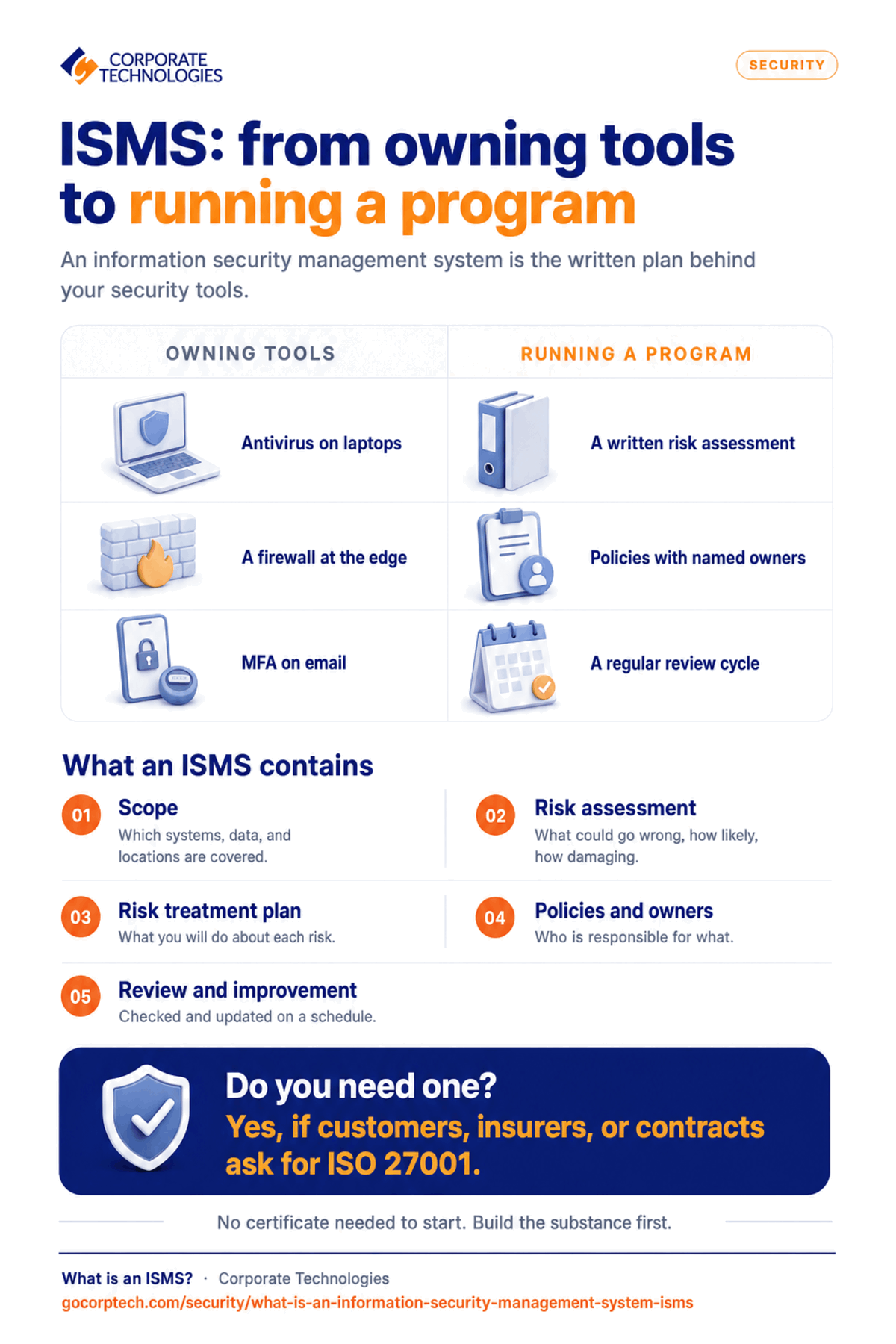
Think of it as the difference between owning security tools and running a security program.
Owning tools looks like: there is antivirus on the laptops, a firewall at the edge, and multi factor authentication on email. Running a program looks like: someone has written down what the business needs to protect, assessed what could go wrong, chosen controls in proportion to that risk, assigned each one an owner, and scheduled a review to check they still work.
The second is an ISMS. The tools are an output of it, not a substitute for it.
What does an ISMS contain?
| Component | What it answers |
|---|---|
| Scope statement | Which parts of the business, systems and locations are covered |
| Risk assessment | What could go wrong, how likely, how damaging |
| Risk treatment plan | What you are doing about each risk, and which you accept |
| Statement of applicability | Which controls apply, which do not, and why |
| Policies and procedures | How people are expected to behave, in writing |
| Roles and responsibilities | Who owns each control, by name or role |
| Incident response plan | What happens when something goes wrong, and who decides |
| Internal audit | Evidence that you check yourselves, not just that you intended to |
| Management review | Leadership engagement, recorded, on a schedule |
| Continual improvement | How findings feed back into the system |
The unglamorous items at the bottom are the ones auditors examine most closely, because they are the hardest to fake and the first to lapse.
Does a small business need an ISMS?
A formal, certified ISMS is a significant undertaking. Whether it is proportionate depends on why you are asking.
You probably do need one
You probably do not need the full formal version
There is a middle path that is often the right one: build the substance of an ISMS, the risk assessment, the written policies, the named owners, the review cycle, without pursuing certification. You get most of the operational benefit and can answer procurement questionnaires honestly. Certification becomes a later decision driven by a specific commercial need.
ISMS, SOC 2, HIPAA and CMMC: how they relate
These are routinely confused, and the distinctions matter when someone is deciding what to spend money on.
ISO 27001 / ISMS
is a management system standard. It is certifiable, international, and broadly applicable across industries.SOC 2
is an attestation report produced by an auditor against trust services criteria. It is common in US technology and service businesses and is a report, not a certification.HIPAA
is US law covering protected health information. There is no official HIPAA certification, despite what some vendors imply. You demonstrate compliance through safeguards and documentation.PCI DSS
is a contractual standard imposed by the card brands on anyone handling payment card data.CMMC
is a US Department of Defense framework for contractors handling controlled unclassified information, with assessment requirements tied to contract eligibility.
A well built ISMS makes each of these easier, because the underlying work, knowing what you hold, what could go wrong, and who owns each control, is shared. It does not make you compliant with any of them automatically.
How an ISMS is built
Define scope.
Narrower is better at the start. An ISMS covering one product line and the systems behind it is achievable. One covering everything usually stalls.Inventory information assets.
What data you hold, where it lives, who can reach it. Most businesses discover during this step that the answer differs from what they assumed.Assess risk.
For each asset, what could go wrong, how likely, how bad. Consistency of method matters more than precision of numbers.Select controls.
Choose in proportion to assessed risk and document why anything was excluded.Write the policies.
Short and followed beats comprehensive and ignored. A policy nobody has read is a liability, because it documents a standard you are visibly not meeting.Assign ownership.
Every control needs a named owner. Controls owned by “IT” are owned by nobody.Operate it.
Run the reviews, log the incidents, keep the evidence.Audit and improve.
Internally first. Certification, if pursued, comes after the system has been running long enough to produce evidence.
Where these efforts usually fail
Three patterns account for most of it.
The documentation set that was bought, not built.
The system with no owner.
Scope that was too ambitious.
The common thread is treating an ISMS as a document to produce rather than a routine to run. The artefacts are a byproduct. The routine is the thing.
What an ISMS is worth when nobody is asking for one
Businesses that build one only because a customer demanded it tend to resent the exercise. The ones that get value from it are usually solving a different problem: they have grown past the point where any single person holds the whole picture in their head.
That threshold arrives quietly. It looks like nobody being certain which supplier has access to the finance system, or whether the contractor who set up the backups still has credentials, or what would actually happen if the operations manager were unavailable for two weeks. None of those are security questions exactly. They are questions about whether the business understands itself.
An ISMS forces those answers onto paper, assigns them owners, and schedules a moment each year when somebody checks whether they are still true. Organizations that have been through an incident often say afterwards that the documentation mattered less than knowing who was supposed to make which decision, which is precisely what the exercise produces.
The certification, if it ever comes, is a side effect.
Frequently asked questions
Is an ISMS the same as ISO 27001?
Not quite. ISO 27001 is the standard that specifies what an ISMS should contain. You can operate an ISMS without seeking certification against the standard, and many businesses sensibly do.
How long does it take to implement?
For a small business with a tight scope, several months of real work before there is enough operating evidence to certify. Anyone promising certification in weeks is selling documents rather than a management system.
Can our IT provider run it for us?
They can run many of the controls and help assemble evidence. They cannot own your risk acceptance decisions, which belong to your leadership, and an auditor will expect to hear that from you rather than from a supplier. Corporate Technologies supports clients’ compliance obligations through Compliance as a Service, which covers audit preparation, policy development and ongoing monitoring, working alongside the accountable people inside the business.
What is the smallest useful version?
A written scope, an asset inventory, a risk assessment you actually did, a short set of policies people have read, named owners, and a calendar entry for review. That is defensible and answers most procurement questionnaires honestly.
Do we need certification to win enterprise business?
Sometimes, and it is worth asking the customer directly rather than assuming. Many procurement teams accept a completed security questionnaire with evidence. Others treat certification as a hard gate. The answer determines whether this is a documentation exercise or an audit project.
Sources
ISMS components are summarized from the published structure of ISO/IEC 27001 and should be confirmed against the current version of the standard itself before use in a certification project. Descriptions of SOC 2, HIPAA, PCI DSS and CMMC are simplified for orientation and are not legal interpretations. Implementation failure patterns reflect Corporate Technologies’ observations and are qualitative.
This article is general information about information security management and is not legal or audit advice. Corporate Technologies supports clients in meeting their own regulatory obligations and does not represent that it holds any certification referenced here. Confirm your specific obligations with qualified counsel or your assessor.
Keep reading
More in Security →
Cybersecurity Insurance in Maryland: What Carriers Now Require from Your IT Infrastructure
Learn what cybersecurity insurance carriers require from Maryland businesses and how managed IT services help meet security controls, compliance, and audit expectations.
Cyber Insurance Requirements in Illinois: What Underwriters Ask For in 2026
What Illinois businesses need for cyber insurance: MFA, EDR, immutable backups, email security. Plus the Illinois laws behind the exposure and policy…
Dental Ransomware Incidents: What Actually Happens
Learn how ransomware attacks dental offices, what happens during an attack, and how backups and security can help you recover safely.
Free, same business day
What would managed IT cost for your team?
Tell us how many computers and users you have. An engineer sends a per-user range, usually the same business day. No credit card, no bot.
- Live service specialist in about a minute, 24/7
- 21 offices across 18 states
- 60-day money-back guarantee
Get your instant IT support estimate
Tell us how many computers and users you have and we send a per-user range, usually the same business day.