
In short
With the increasing number of online businesses, digital transformation, and the adoption of continuously changing technological trends, it is safe to say that cybersecurity will forever remain a relevant topic. As long as people, institutions,
In this article
What a cybersecurity framework is, and what it is not
A cybersecurity framework is a structured set of practices for managing cyber risk. It tells you what to do and roughly in what order, so you are not guessing which control matters most.
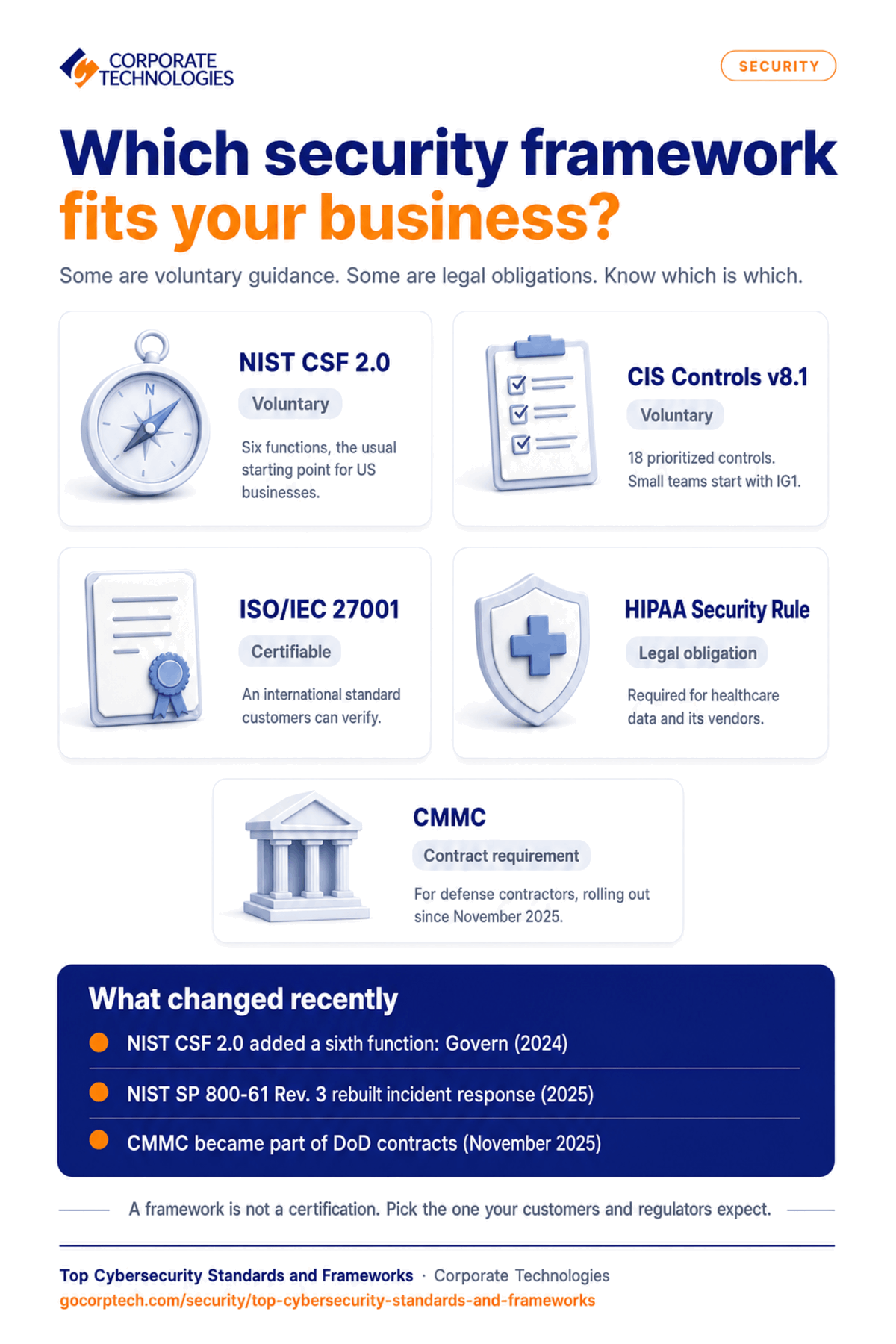
What a framework is not is a certification, and the distinction matters commercially. Some frameworks are voluntary guidance you adopt because it is sensible. Others are legal obligations that apply to your industry whether you like them or not. A third group are certifications that a customer or regulator can require you to hold and prove. Confusing the three is how businesses end up claiming compliance they do not have, which is worse than claiming nothing.
What changed recently
Three things have moved in the past two years that most guidance on this topic has not caught up with.
NIST CSF 2.0 arrived in February 2024 Govern
NIST SP 800-61 Revision 3 landed in April 2025
CMMC became contractually real on 10 November 2025
The frameworks worth knowing
NIST Cybersecurity Framework 2.0
The most widely adopted voluntary framework in the United States, and the usual starting point for a business that has no regulatory obligation forcing a particular choice.
Six Functions: Govern, Identify, Protect, Detect, Respond, Recover. It is deliberately outcome-based rather than prescriptive, which makes it adaptable but also means it will not hand you a checklist. Free, published by NIST.
CIS Critical Security Controls v8.1
Eighteen controls, ordered by priority, grouped into three Implementation Groups so a small business can start with IG1 and grow into the rest. Where CSF tells you what outcomes to aim for, CIS tells you what to do on Tuesday morning. For most SMBs it is the more actionable of the two, and the two map to each other cleanly.
ISO/IEC 27001
An international standard for an information security management system, and one you can be formally certified against by an accredited body. That certification is the reason it comes up: enterprise customers and international partners often ask for it contractually. The current version is the 2022 revision. Achieving it is a substantial program of work, not a configuration exercise.
HIPAA Security Rule
A legal obligation for covered entities and their business associates, not a voluntary framework. It requires administrative, physical and technical safeguards for electronic protected health information.
Worth being precise here, because a lot of published material currently is not. HHS issued a notice of proposed rulemaking on 27 December 2024 proposing significant strengthening of the Security Rule. That proposal is not final.
PCI DSS
Required contractually by the payment card brands for any business that stores, processes or transmits cardholder data. Not a government regulation, but enforceable through your merchant agreement, and the fastest route to reducing scope is usually to stop handling card data directly.
CMMC
The Department of Defense program verifying that contractors protect controlled unclassified information. The DFARS rule took effect on 10 November 2025, starting a three-year phase-in, and CMMC requirements now appear in solicitations.
Level 1 covers basic safeguarding with annual self-assessment. Level 2 aligns to NIST SP 800-171 and, for most contracts, requires assessment by an accredited third party. Level 3 adds requirements for the highest-priority programs. If you are anywhere in the defense supply chain, this stopped being theoretical.
SOC 2
An attestation report produced by an independent CPA firm, commonly requested by enterprise buyers of software and services. Not a certification and not a government standard, but frequently the thing standing between a vendor and a large contract.
How to choose
Work through it in this order.
First, what is compulsory?
Second, what do your customers demand?
Third, what does your insurer expect?
Finally, what improves your actual security?
Most SMBs end up with one compulsory framework and one voluntary one, and that is a reasonable place to be. Adopting four frameworks properly is harder than adopting one, and a framework adopted badly is documentation rather than security.
Which framework fits which situation
A rough guide, and the reason most businesses need fewer frameworks than they fear.
A 30-person professional services firm with no regulatory obligation.
A medical practice.
A manufacturer selling into the defense supply chain.
A software company selling to enterprises.
Anyone taking card payments.
What adoption actually involves
Choosing is the easy part, and it is where most articles stop.
Assess honestly.
Prioritize by risk, not by effort.
Assign ownership with names.
Produce evidence as you go.
Reassess on a schedule.
Frequently asked questions
Which framework should a small business start with?
CIS Controls Implementation Group 1, unless a regulator or a customer has already decided for you. It is prioritized, practical, and achievable for a business without a security team.
Is NIST CSF a certification?
No. It is voluntary guidance, and there is no body that certifies you against it. You can say you align to it. You cannot be certified in it.
Does following a framework make us compliant?
Not automatically. Frameworks and regulations overlap but are not the same thing. CIS Controls will improve your HIPAA position substantially without being HIPAA compliance in itself.
How long does ISO 27001 certification take?
For most small and mid-sized organizations, a year is a realistic planning assumption from start to certificate, and it is a management-system program rather than a technical project.
Do we need more than one framework?
Most businesses end up with one compulsory obligation and one voluntary framework for structure. Adopting four properly is harder than adopting one, and a framework adopted badly is documentation rather than security.
Does CMMC apply to us if we are a subcontractor?
Frequently yes. Requirements flow down through the supply chain, so if controlled unclassified information reaches you, the obligation typically does too. Check your contracts rather than assuming.
A note on what we can and cannot claim
Corporate Technologies helps clients meet their own obligations under these frameworks. That is a different statement from Corporate Technologies holding a given certification, and any provider who blurs the two is worth a follow-up question. If a control matters to your compliance position, ask specifically who holds what, and get it in writing.
Where a managed provider helps
Frameworks fail in implementation, not selection. The gap is rarely knowing that MFA is required. It is enforcing it across every account, keeping it enforced as people join and leave, and being able to demonstrate it a year later to an auditor or an insurer.
We map your obligations, implement and enforce the controls, and produce the evidence when someone asks for it. Contact us or call 1-866-363-4628.
Sources
This page is general guidance and not legal, regulatory or insurance advice. Standards, rules and reporting obligations change, and the requirements that apply to your business depend on your sector, your contracts and your location. Corporate Technologies helps clients meet their own obligations and does not represent that it holds any particular certification unless stated. Confirm current requirements with your legal, compliance and insurance advisers.
Keep reading
More in Security →
Cybersecurity Insurance in Maryland: What Carriers Now Require from Your IT Infrastructure
Learn what cybersecurity insurance carriers require from Maryland businesses and how managed IT services help meet security controls, compliance, and audit expectations.
Cyber Insurance Requirements in Illinois: What Underwriters Ask For in 2026
What Illinois businesses need for cyber insurance: MFA, EDR, immutable backups, email security. Plus the Illinois laws behind the exposure and policy…
Dental Ransomware Incidents: What Actually Happens
Learn how ransomware attacks dental offices, what happens during an attack, and how backups and security can help you recover safely.
Free, same business day
What would managed IT cost for your team?
Tell us how many computers and users you have. An engineer sends a per-user range, usually the same business day. No credit card, no bot.
- Live service specialist in about a minute, 24/7
- 21 offices across 18 states
- 60-day money-back guarantee
Get your instant IT support estimate
Tell us how many computers and users you have and we send a per-user range, usually the same business day.