


In short
Stop letting your inbox run your day. This simple 20-minute morning routine helps business owners focus on what matters most.
In this article
- Why Mornings Quietly Control Your Entire Day
- A 20-Minute Reset That Fits Real Life
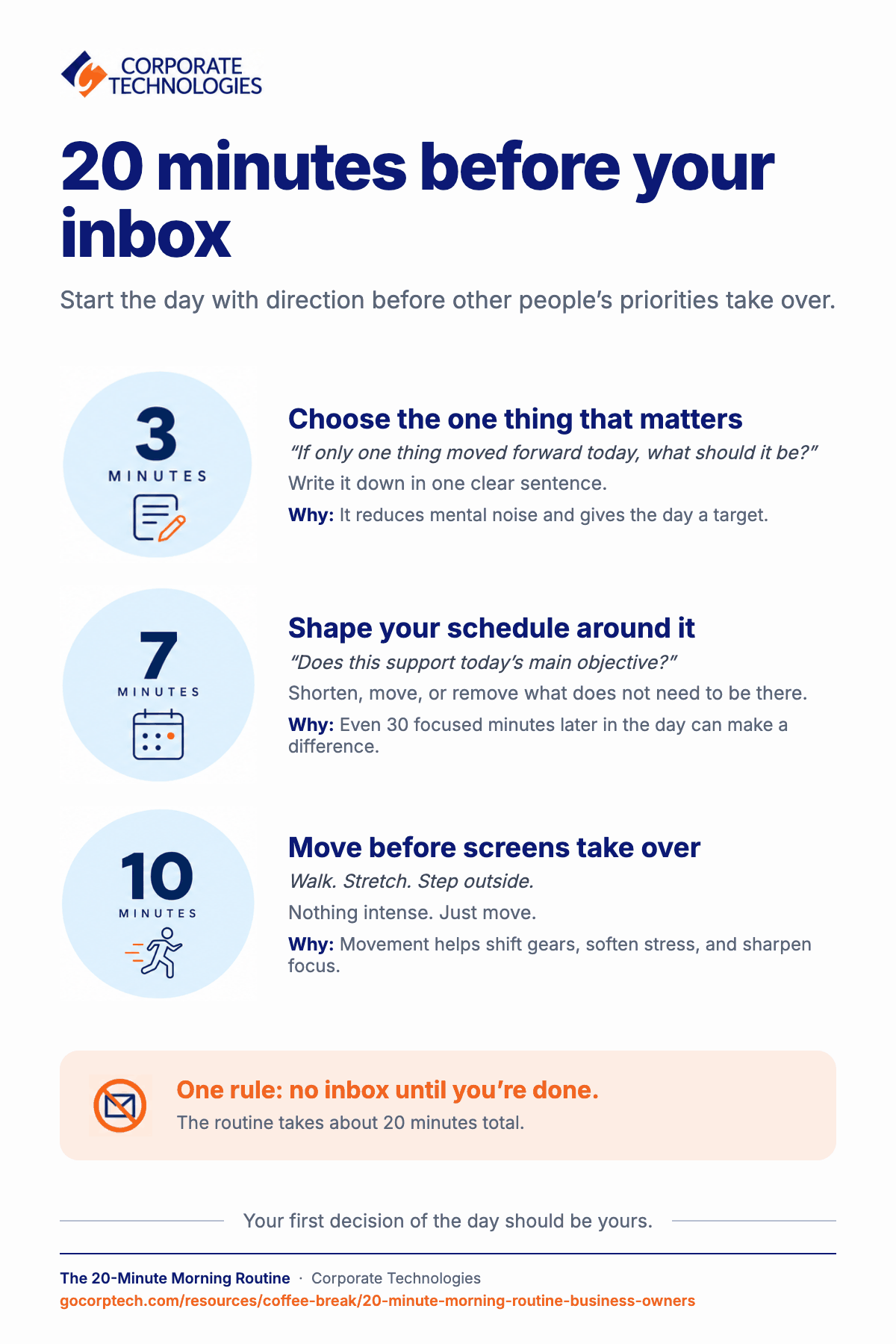
- Step 1: Decide The One Thing That Counts Today (3 minutes)
- Step 2: Shape your schedule around that priority (7 minutes)
- Step 3: Get Out Of Your Head And Into Your Body (10 minutes)
- Why This Works Better Than Willpower
- Try This Before Dismissing It
There’s a familiar scene most business owners don’t even question anymore.
The alarm buzzes. Your hand reaches for the phone before your eyes fully open. Notifications stack up. Messages. Emails. Slack pings. Calendar reminders.
By the time you’re out of bed, your mind is already running. No shower, no breakfast, and somehow it still feels like you’re behind. From there, the day starts belonging to everyone else.
Clients need answers. Staff needs direction. Something broke overnight. Something always does. You spend hours responding, reacting, fixing. You work all day, yet that important thing you meant to get to keeps sliding to tomorrow.
For a while, this just felt like how business worked. It doesn’t have to.
Why Mornings Quietly Control Your Entire Day
Most business owners don’t actually struggle with managing time. The real issue starts earlier than that. It starts with how the day begins.
When the first thing you do is open your inbox, control slips away immediately. Each email asks for a decision. Each message pulls focus somewhere else. Before the morning is even half over, your brain already feels tired.
Now compare that to starting the day by choosing what truly matters first.
One path leads to constant cleanup. The other leads to progress.
The difference isn’t motivation. It’s sequence. What you do before opening email changes everything.
A 20-Minute Reset That Fits Real Life
This isn’t a productivity fantasy. No cold plunges. No sunrise journaling marathons. No pressure to wake up earlier than your body wants to.
Just three small actions. Total time: about 20 minutes.
Do them before email. That’s the only rule.
Step 1: Decide The One Thing That Counts Today (3 minutes)
Grab a pen. Not your phone. Not a fancy system.
You need to ask yourself: If only one thing actually moved forward today, what should it be?
This is not the loudest task. Not the thing with the most messages attached. Not the fire burning hottest.
It’s the action that actually pushes the business ahead. Write it down. One sentence. Clear and specific.
This does two things:
- It reduces mental noise.
- It gives your day a target.
Even if everything else goes sideways, this keeps you anchored.
Step 2: Shape your schedule around that priority (7 minutes)
Now look at what your day currently has planned. Meetings. Calls. Check-ins. Blocks that exist simply because they always have.
Ask yourself:
- Does this support today’s main objective?
- Can this be shorter?
- Can this be moved?
- Can this disappear altogether?
You don’t need permission to protect your time. You just need to decide that it matters.
Even freeing up 30 focused minutes later in the day makes a difference. This is where intention turns into structure.
You’re not avoiding responsibility. You’re choosing effectiveness.
Step 3: Get Out Of Your Head And Into Your Body (10 minutes)
Before screens fully take over, move a little. Walk. Stretch. Step outside. Shake off stiffness. Nothing intense. Nothing measured. Just movement.
This isn’t about fitness. It’s about shifting gears.
A moving body wakes up a thinking brain. Stress softens. Focus sharpens. You stop feeling like you’re dragging yourself into the day.
Ten minutes is enough.
Why This Works Better Than Willpower
There’s solid research showing that mental energy is limited. Every choice you make drains it slightly. When your day starts with dozens of tiny decisions from other people’s messages, you burn fuel fast.
Starting with a deliberate choice flips the script. Your first decision becomes yours.
That sets the tone. You respond differently. You prioritize more clearly. You say no faster. You work with direction instead of pressure.
“But What If Something Urgent Happens?”
This comes up every time.
“I have staff who message early.”
“Clients expect quick replies.”
“Things blow up without warning.”
Here’s the truth: real emergencies don’t arrive quietly.
If something is truly critical, someone will call. Repeatedly. Texts, notifications, and emails can wait 20 minutes.
Set the expectation once. Let people know mornings are for planning and clarity. You’ll be amazed how quickly the world adjusts.
Most “urgent” messages weren’t urgent at all. They just felt that way because you saw them too soon.
Try This Before Dismissing It
Don’t turn this into a long-term commitment. No habit tracking. No pressure.
Just try it for five weekdays. Same steps. Same order. No inbox until you’re done.
Pay attention to how the rest of the day feels:
- Are you calmer?
- Are decisions easier?
- Does important work actually get touched?
If nothing changes, go back to scrolling under the covers. No harm done. But if your days start feeling less chaotic and more deliberate, you’ll know why.
Sometimes, the biggest shift in how we work starts with not opening email just yet.
Keep reading
More in Coffee Break Reads →
Multitasking Is Slowing You Down (And Increasing Risk)
Multitasking feels productive, but your brain is switching gears and paying for it in lost time, more mistakes and more stress. Here…

What Happens When You Click “Remind Me Later” Too Many Times
That little "Remind me later" button feels harmless. But a hundred clicks later, your devices are out of sync and the security…
Stop Searching for Files: 5 Tips That Actually Work
Save time and find files faster with 5 practical file organization tips, smarter naming habits, better search, and simple maintenance routines.
Free, same business day
What would managed IT cost for your team?
Tell us how many computers and users you have. An engineer sends a per-user range, usually the same business day. No credit card, no bot.
- Live service specialist in about a minute, 24/7
- 21 offices across 18 states
- 60-day money-back guarantee
Get your instant IT support estimate
Tell us how many computers and users you have and we send a per-user range, usually the same business day.