

In short
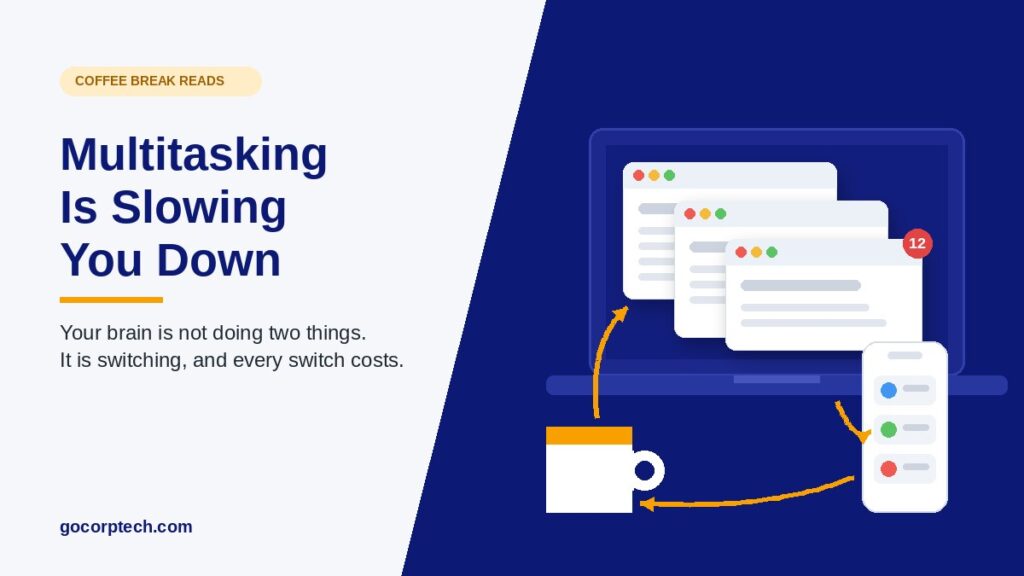
Multitasking feels productive, but your brain is switching gears and paying for it in lost time, more mistakes and more stress. Here is how to do one thing well.
In this article
You know the move. You are on a call you only half need to be on, so you start clearing your inbox. A text comes in, so you answer that. Then the person on the call asks you something and you have no idea what they said. We have all done it, and we usually come away feeling busy and oddly unproductive at the same time.
Your Brain Is Switching, Not Multitasking
There is a reason for that feeling. Your brain cannot really do two things at once. What it does is flip back and forth between them, and every flip costs you something. The American Psychological Association puts it plainly: the small mental stalls that come with switching tasks can eat up to 40% of your productive time. And once something pulls you away, climbing back in is harder than it feels. Gloria Mark, a researcher at UC Irvine who has studied this for years, found it takes around 23 minutes to get back to what you were doing. So that “quick glance” at your phone is rarely quick. It leaves a wake.
The Mistakes Nobody Counts
Lost time is the part everyone talks about. What gets less attention is how much multitasking raises the odds of getting something wrong, sometimes in ways that matter.
Think about the drive home. NHTSA says reading a text pulls your eyes off the road for about five seconds. At 55 miles per hour, that is the length of a football field traveled blind. Nobody decides to drive a hundred yards with their eyes shut, but that is the deal we make every time we grab the phone at a light that just turned green.
It shows up in smaller ways too. The bill you pay twice because the TV was on. The pan you leave too long while you fire off “one quick email.” The call you make at 4:55 on a Friday with three tabs open and your mind already in the parking lot. None of these is a big deal on its own. They add up, and they tend to show up when you are already stretched thin.
The Quieter Cost
Then there is the toll nobody measures. Bouncing between things all day wears you out in a way that is hard to explain to someone who thinks you “just sat at a desk.” You end up frazzled, a little wired, with not much to show for it. You were there for all of it and really in none of it.
Do One Thing
The fix is not a new system. It is mostly doing one thing until it is finished. Give a task a real block of time, even twenty-five minutes, before you let anything cut in. Shut off the notifications that do not actually need you, and let email and chat wait until you choose to look. When you are driving, put the phone somewhere you cannot reach it. And when you are with people you care about, be with them. The group chat will survive.
None of this is a willpower failure, by the way. Every app on your phone is built to pull you back, and they are very good at it. Treat it as a design problem rather than a character flaw, and change the design around you.
The Coffee Break Takeaway
This month, pick one moment a day to do a single thing from start to finish with nothing else running. A coffee with no screen. One task, one tab. See how it feels. Our bet is you will get more done, notice more of what is around you, and feel a bit more like yourself.
Enjoy your coffee break.
Keep reading
More in Coffee Break Reads →
What Happens When You Click “Remind Me Later” Too Many Times
That little "Remind me later" button feels harmless. But a hundred clicks later, your devices are out of sync and the security…
Stop Searching for Files: 5 Tips That Actually Work
Save time and find files faster with 5 practical file organization tips, smarter naming habits, better search, and simple maintenance routines.

Your Browser Knows More About You Than You Think
Your browser knows more about you than you think. Discover how browsing habits shape your online experience and ads.
Free, same business day
What would managed IT cost for your team?
Tell us how many computers and users you have. An engineer sends a per-user range, usually the same business day. No credit card, no bot.
- Live service specialist in about a minute, 24/7
- 21 offices across 18 states
- 60-day money-back guarantee
Get your instant IT support estimate
Tell us how many computers and users you have and we send a per-user range, usually the same business day.