

In short
Kids often fix tech faster than adults because they explore without fear. Learn how curiosity, experimentation, and mindset make troubleshooting easier.
In this article
- Kids Don’t Overthink the Problem
- They’re Not Afraid of Breaking Things
- Kids Learn Tech by Doing, Not Reading
- Tech Is Their Native Language
- They Don’t Take It Personally When Tech Fails
- What Adults Can Steal From Kids (Without Borrowing Their Phones)
- Why This Matters at Work Too
- A Final Thought Over the Last Sip
Ever notice this strange thing? A printer just stops. Wi-Fi drops. An app freezes for no clear reason at all.
An adult sighs. Rubs the forehead. Says something like, “It was working five minutes ago.”
Then a kid shows up. They tap a few buttons. Swipe once. And somehow, it’s fixed. No manual. No stress. Just done.
It almost feels unfair. A little annoying too.
But there’s a reason kids seem to fix tech faster than adults. Actually, a few reasons. And it’s not because they’re smarter. It’s more about how they think. How they approach problems. And how little fear they bring into it.
Let’s break it down over coffee.
Kids Don’t Overthink the Problem
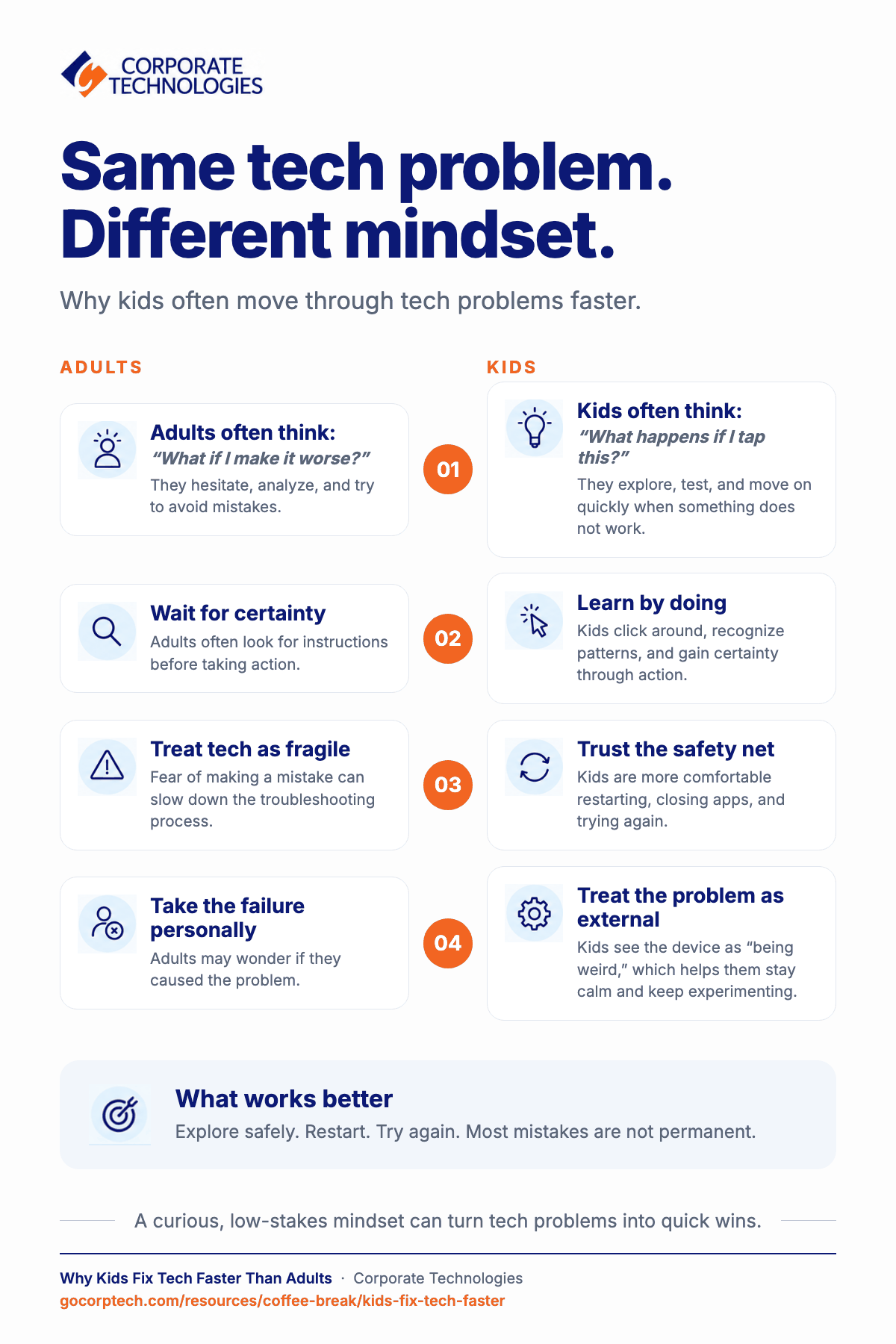
Adults come with history. We remember past failures and crashes. That one time, clicking the wrong thing broke everything. So we hesitate and analyze. We try to do it the right way.
Kids don’t have that baggage. They don’t think, “What if this makes it worse?” They think, “What happens if I tap this?”
That curiosity-first mindset matters. Tech problems usually don’t need perfect logic. They need exploration. Kids are very good at that.
They poke around. They test. They aren’t embarrassed if something doesn’t work. They just try the next thing. Adults often stop after one failed attempt. Kids barely notice the failure.
They’re Not Afraid of Breaking Things
Most adults treat technology like it’s fragile glass. One wrong click and everything might collapse. You can almost see the hesitation. The slow mouse movement. The deep breath before touching anything.
Kids don’t do that.
To them, tech feels more like a puzzle on the table. Something meant to be played with. They tap. They swipe. They close apps and open them again without thinking twice. No drama. No fear.
They also assume the system can handle it. And honestly, most of the time, it can.
Undo buttons exist for a reason. Reset options are built in. Apps freeze and recover. Devices restart and move on as if nothing happened. Kids trust that safety net. They don’t question it.
Adults usually do. What if this makes it worse? That thought slows everything down.
Fear adds pressure. Pressure clouds thinking. Confidence, even casual confidence, clears the path. That’s why kids often fix things faster. They’re not scared to try.
Kids Learn Tech by Doing, Not Reading
Adults love instructions. Kids ignore them completely.
A new app? Adults look for a guide. Kids just open it.
They learn by clicking around. They see patterns fast. Menus feel familiar across apps. Icons repeat. Settings usually live in the same places.
That hands-on learning sticks better. It becomes instinct. Adults often want certainty before action. Kids gain certainty through action.
Tech Is Their Native Language
This part matters. Kids didn’t adopt technology. They grew up inside it.
Touchscreens, voice assistants, and apps are updating overnight. All normal. No adjustment period. No learning curve shock.
Adults remember when tech worked differently. Or didn’t exist at all. So every update feels like something new to relearn.
Kids don’t compare. They just accept the current version as reality. That flexibility makes them faster.
They Don’t Take It Personally When Tech Fails
Adults often feel blamed by broken tech. “Did I do something wrong?” or “Did I mess this up?”
Kids don’t think like that. To them, tech issues are external. The device is being weird. Not them. That emotional distance helps. They stay calm. They stay playful.
And calm minds solve problems better.
What Adults Can Steal From Kids (Without Borrowing Their Phones)
Here’s the good news. You don’t need to be younger to think younger.
A few habits help:
- Click around safely. Explore before assuming it’s complicated.
- Restart without shame. It fixes more than people admit.
- Stop assuming mistakes are permanent. Most aren’t.
- Treat tech like a system, not a judgment on your skills.
When adults loosen up, they solve tech faster, too.
Suggested Read: Keyboard Shortcuts That Save You 10 Minutes a Day
Why This Matters at Work Too
This isn’t just about phones and tablets.
The same mindset shows up in workplaces. Employees who aren’t afraid to explore tools adapt faster. Teams that treat systems as flexible learn quicker.
And companies that encourage curiosity instead of fear see fewer small issues turn into big ones.
Tech isn’t magic. It’s just layers of logic. Kids happen to approach those layers with less pressure.
A Final Thought Over the Last Sip
Next time something breaks, notice your first reaction. Is it frustration? Or curiosity?
If a kid were standing there, they wouldn’t sigh. They’d tap.
That small shift in attitude often makes the biggest difference.
And if you ever find yourself thinking about how technology, people, and real-world decisions intersect every day, that’s a conversation worth continuing.
At Corporate Technologies, we believe clear thinking, adaptability, and calm problem-solving matter just as much in legal work as they do in tech. Whether it’s navigating systems, processes, or challenges, a fresh perspective goes a long way.
Keep reading
More in Coffee Break Reads →
Multitasking Is Slowing You Down (And Increasing Risk)
Multitasking feels productive, but your brain is switching gears and paying for it in lost time, more mistakes and more stress. Here…

What Happens When You Click “Remind Me Later” Too Many Times
That little "Remind me later" button feels harmless. But a hundred clicks later, your devices are out of sync and the security…

Stop Searching for Files: 5 Tips That Actually Work
Save time and find files faster with 5 practical file organization tips, smarter naming habits, better search, and simple maintenance routines.
Free, same business day
What would managed IT cost for your team?
Tell us how many computers and users you have. An engineer sends a per-user range, usually the same business day. No credit card, no bot.
- Live service specialist in about a minute, 24/7
- 21 offices across 18 states
- 60-day money-back guarantee
Get your instant IT support estimate
Tell us how many computers and users you have and we send a per-user range, usually the same business day.