In short
Learn how managed IT for dental practices improves HIPAA compliance, imaging systems, uptime, backups, and 24/7 support for dental offices.
In this article
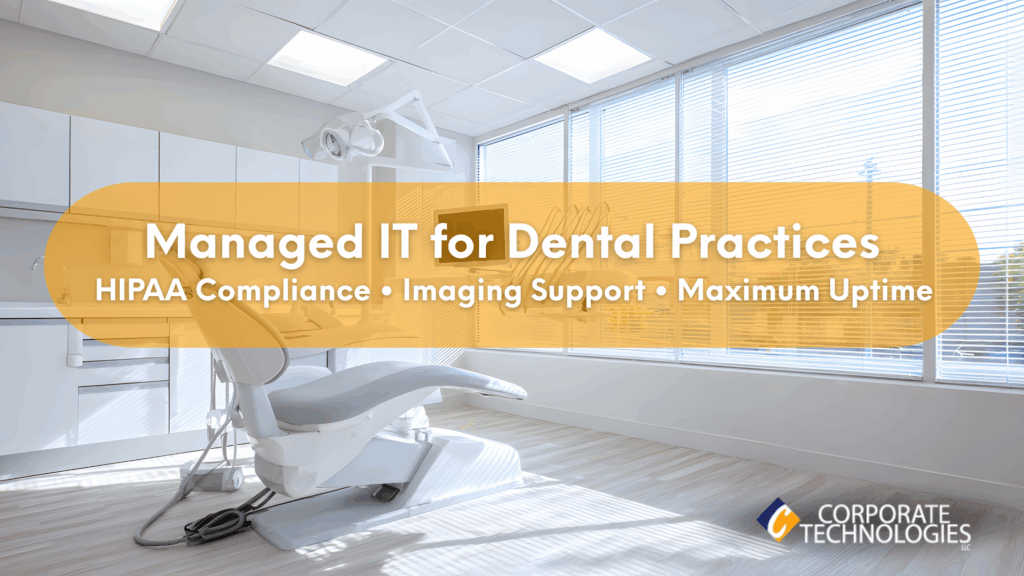
Digitizing your healthcare documents reduces so much physical paperwork, but it also adds cybersecurity risks and additional IT maintenance to your business. Downtime, stolen data, and data corruption are three risks healthcare businesses face, especially if they don’t stay fully compliant with HIPAA regulations. To avoid these issues and more, managed IT for dental practices can free up staff time, reduce risks of data corruption and loss, and secure the network environment in case of a disaster.
If you own a small dental practice, you might take care of small IT tasks, but eventually you need help, especially when you need to ensure that your infrastructure follows HIPAA guidelines. HIPAA violations can add up to millions after a data breach, so we put together a list of ways a managed service provider can help keep your business compliant and keep data safe from attackers.
Backups and Disaster Recovery
Let’s say that you store your imaging files on a central computer so that everyone on staff can access patient documents. Data on this central server must be backed up in a safe location or you could lose your files forever. When healthcare providers lose patient data, it can be disastrous for business continuity. Having backups of patient files is also a requirement for HIPAA regulations.
A managed service provider will assess your IT infrastructure and propose a good backup plan. Backup plans incorporate the number of file changes done throughout the day and determine how much loss you can experience without going bankrupt. Your backup plan might be daily, hourly, or more frequently.
With your risk tolerance defined, managed IT professionals determine where to store backups and the frequency of data backups. Most professionals use cloud storage, where additional space and scaling can be done dynamically. Cloud storage also ensures that data is safe even in the event of a fire or physical theft. With disaster recovery, you have peace of mind that patient data can be restored and bring your business back to productivity within a reasonable amount of time.
User Onboarding and Account Setup
When a dental practice hires a new user, the user needs an account, a workstation, and access to necessary business applications. If a few new people join the team, it can be a lot of prep work for someone managing IT themselves. A Dental IT service provider takes care of onboarding for every new user, including deployment of workstations and mobile device applications.
Documentation for onboarding and offboarding is necessary. Most people know that onboarding is necessary but forget the offboarding process. Without offboarding, ex-employee user accounts stay active, which creates a cybersecurity risk. User accounts must be deactivated and data transferred to another staff member to continue productivity. An IT provider handles this activity as well.
In addition to user account activation and deactivation, IT professionals can give you HIPAA compliant application suggestions when your current infrastructure isn’t enough. Suppose that you have productivity issues due to the way documents are digitally stored. A dental office can speed up productivity with a few changes to its current application workflow, especially if they work with hybrid environments in the cloud.
Help Desk Services and Onsite Help
Users need to ask questions about their workstations, applications, or bugs in the system. Managed IT professionals at a 24/7 help desk assist dental staff with minor questions related to their work and even have on-site staff to help with bigger issues. Help desk services can assist your staff with various issues remotely and give them someone to call instead of interfering with local staff productivity.
Not every managed IT provider offers a 24/7 help desk. It’s important to check your contract and ask questions. Also, on-site help is often needed throughout the year. Your contract should have a flat rate for on-site help with a service level agreement (SLA). SLAs give you the amount of time that you can expect a response and resolution for each IT item. SLAs are based on priority, so you get the fastest response for issues that interfere with day-to-day business productivity.
Be careful of contracts that charge an hourly rate for on-site help in addition to monthly IT expenses. Without onsite support included with flat-rate payments, IT costs can balloon to unexpected amounts when a critical issue brings down infrastructure. Providers like Corporate Technologies include on-site support with their Total Advantage pricing plan.
Monitoring and IT Management
Even a small network needs day-to-day management. For example, software and firmware need upgrades often to patch security issues and bugs. An IT management professional monitors your environment for these updates and applies them. Patching is done in the background without affecting your user productivity or business operations.
Many of today’s current data breaches come from unpatched infrastructure, so it’s important to keep up with updates. For example, an outdated IoT device could lead to your network becoming a part of a botnet. A botnet is the component behind a distributed denial-of-service (DDoS). Not only would your network be responsible for taking down another corporate business, but a DDoS from your network exhausts your business bandwidth, affecting productivity, digital downloads and uploads, and any payments.
Where to Get Dental Practices IT Help
If your office is overwhelmed with IT issues and needs help, a managed service provider is an affordable solution. Instead of hiring full-time staff, an MSP offers a complete team of IT professionals at a per-user flat-rate cost. The 24/7 help desk is also an option if your dental practice has people working remotely or during off-peak hours.
Corporate Technologies has several offices across the country, and they offer service plans to fit your dental practice’s IT budget. Call us today and talk to one of our professionals to find out how we can help your dental practice.
FAQs
Business continuity and data backups for patient information are a part of HIPAA compliance.
Backups should be done at least daily, but a dental office might need a higher frequency of backups if more data is stored hourly.
Without a full-time IT staff member, dental offices can work with managed service providers to maintain and upgrade office infrastructure.
A managed IT provider will assess current cybersecurity and implement a plan including backups, monitoring, and disaster recovery.
A help desk gives employees a place to call for help and manages tickets for on-site help for more critical issues.
Keep reading
More in Business IT 101 →
Most SMB Security Stats Are Confident Claims. We Published the Operational Data Instead.
We published our real Q2 2026 operational data across ~1,700 SMBs, including a patch number that dropped 29 points the moment we…

Patch Management Explained: Why Unpatched Systems Get Breached
Learn why patch management is critical for business security. Discover how unpatched systems get breached, real-world examples like WannaCry, and how Corporate…

AI in Cybersecurity: What It Really Means for Small and Mid‑Sized Businesses
Explore AI in cybersecurity and discover its impact on small and mid-sized businesses in today's digital landscape.
Free, same business day
What would managed IT cost for your team?
Tell us how many computers and users you have. An engineer sends a per-user range, usually the same business day. No credit card, no bot.
- Live service specialist in about a minute, 24/7
- 21 offices across 18 states
- 60-day money-back guarantee
Get your instant IT support estimate
Tell us how many computers and users you have and we send a per-user range, usually the same business day.